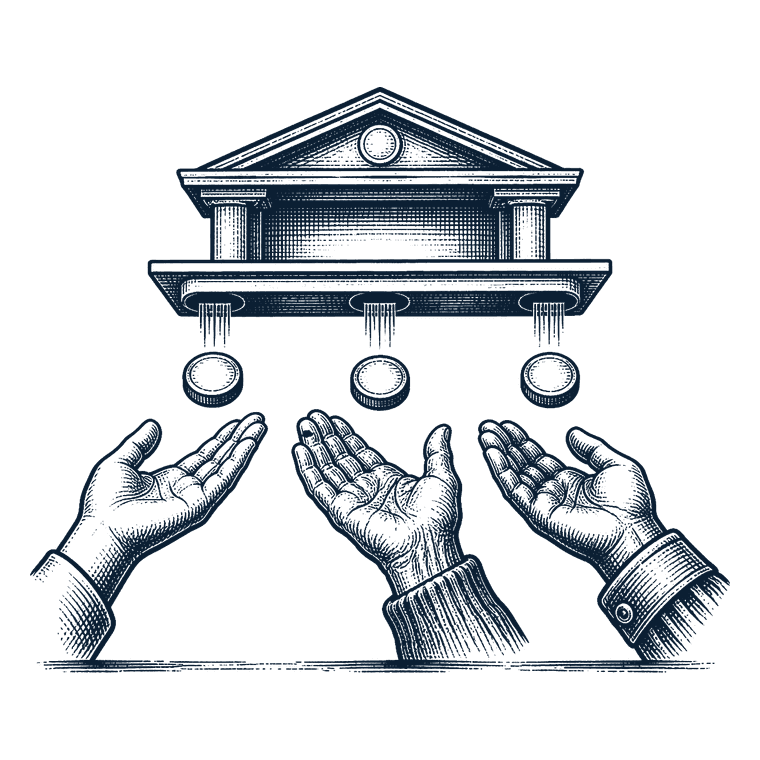
We begin by giving everyone the benefit of the doubt.Our starting assumption is that people and institutions generally believe they are doing the right thing. Most advocates sincerely believe their position will lead to a better outcome.
At the same time, people can be influenced by incentives, responsibilities, experiences, and competing interests—sometimes consciously and sometimes unconsciously. The possibilities below are not accusations or conclusions. They are questions worth considering and testing against evidence.
BENEFIT OF THE DOUBT
Charitable Motivations
- Prevent destitutionExample: Supporters may sincerely believe no person should fall below a basic material floor because of unstable work, illness, caregiving, or administrative delay.
- Respect individual agencyExample: Recipients may understand whether rent, food, transportation, training, childcare, or debt is most urgent better than an eligibility office.
- Protect people with greater needsExample: Critics may genuinely want limited resources concentrated on disability, medical, housing, and caregiving costs that a flat payment cannot cover.
- Preserve work and reciprocityExample: Opponents may worry that a durable safety system still requires employment, tax revenue, and a shared expectation of contribution where people are able.
- Prepare for economic disruptionExample: Supporters may believe automation, contract work, recessions, and unstable hours require support that reaches people before a crisis.
POSSIBILITIES, NOT CLAIMS
Potential Hidden Agendas
- Reducing public servicesExample: Some advocates may prefer a visible flat payment partly because it creates an argument for eliminating more expensive or demanding social programs.
- Protecting existing bureaucracyExample: Agencies or organizations may resist simpler cash delivery partly because current eligibility programs sustain budgets, staffing, authority, or influence.
- Subsidizing low wagesExample: Employers may support public cash if taxpayers absorb living costs that businesses would otherwise face pressure to cover through compensation.
- Political brandingExample: Leaders may promote or condemn UBI as an ideological signal without specifying the taxes, replaced programs, or household-level consequences.
- Electoral influenceExample: Visible recurring payments may create political loyalty or allow opponents to portray recipients as dependent, even when the underlying policy evidence is mixed.
THE REFEREE’S OBSERVATION
More than one motivation can be true.
Someone can sincerely believe they are doing the right thing while also benefiting personally or institutionally if their preferred outcome succeeds. These explanations are not mutually exclusive. Look for evidence before assigning a motive.
Questions the Referee would ask
- What evidence supports the charitable explanation?
- What evidence supports an incentive-based explanation?
- Could both explanations be true at the same time?
- Would this person likely take the same position without a personal benefit?
- What evidence would change my mind?
Reasoning Referee is not here to influence how you think. It is here to improve the quality of your thinking.
Rather than advocating for one viewpoint, it encourages intellectual curiosity, fairness, and critical evaluation—so the conclusion you reach is genuinely your own.
Good reasoning doesn’t guarantee the right answer—but it dramatically improves your chances of finding one.